1536 Review
“Kings don’t kill their wives, do they?”
Tudor England has always been my favourite period of history- a family passion passed down through TV dramas, film, books, endless conversations and, once I moved to the UK, visits to palaces and historic homes. So a play set in the feverish spring of 1536, when Anne Boleyn was arrested, tried and executed, was always going to draw me in. Nearly 500 years after her death Anne Boleyn still casts a long shadow, and ‘1536’ leans into that legacy with a historical drama framed by a distinctly modern edge.
Set in rural Essex, far from the court but never free of its reach, the play follows three women as they learn about the events in London, and how the downfall of the Queen threatens to cost them everything. Anna is sassy and strong willed; Marielle is a midwife with a broken heart; Jane just wants to have a “good” marriage. It’s about female friendship but also the forces that shape women’s lives.
Power sits at the heart of the play — namely the power men hold over women. But also the power a woman can wield through her body; the power married women hold over unmarried women; the power “good” women wield over those judged less respectable; the power of labels and perceptions. Much of women’s history — especially the lives of ordinary women — was never recorded. Fiction becomes a way to imagine what they might have thought, felt, or said to one another. ‘1536’ steps into that gap with empathy and urgency.
One of the women asks whether things will ever change for women. Another answers that she doesn’t know. It’s a bleak exchange — and a pointed one. On May 18th, it will be 490 years since Anne Boleyn’s death. The play invites us to consider what has changed and what hasn’t: domestic abuse persists, sexual assault remains widespread, and misunderstandings around consent continue to harm women. It also shows how the behaviour of powerful men shapes the attitudes and actions of other men.
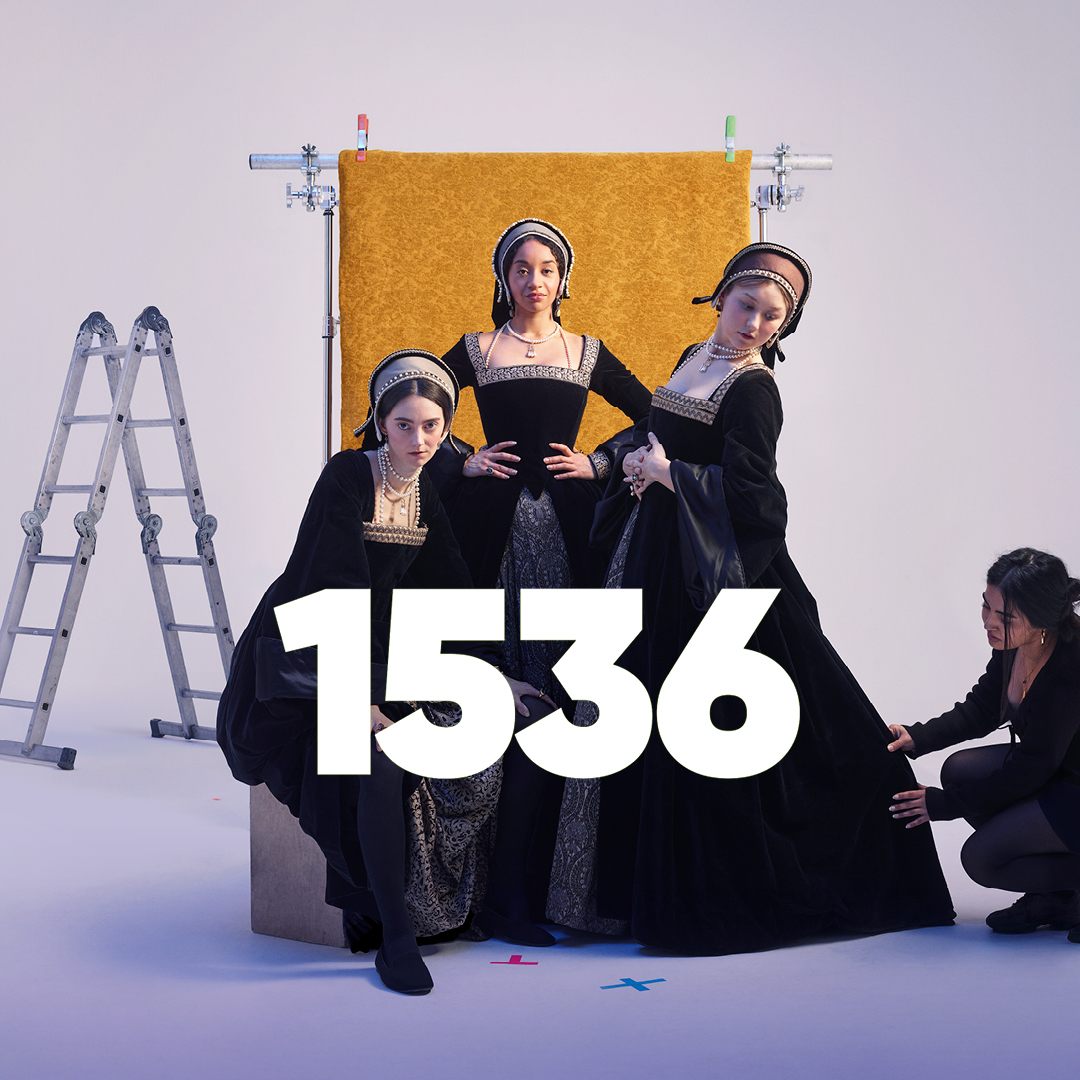
Max Jones’s set captures the oppressive heat of that spring: dry grass, a bare tree, a landscape that already feels scorched. Jack Knowles’s lighting adds another layer, with a horizon that shifts colour across a screen at the back — pale blue for day, violet for dusk, and a striking red at the climax. It’s a simple, atmospheric design that creates contrast without ever changing location. Frequent short blackouts punctuate the scenes. Jones’s costumes place the characters firmly in their historical period, with earthy colours and occasional purples and blues that echo the production’s palette.
At just under two hours with no interval, the play moves with steady momentum, though some plot turns are predictable. The dialogue is fast and witty, with flashes of humour — the audience particularly loved the line about “turning over new leaves”. The conversational style feels true to life; the way the characters jump between topics and loop back again mirrors exactly how my friends and I talk. The strong language lands well in some moments, though it doesn’t always feel necessary. Under Lyndsey Turner’s direction, the staging remains dynamic despite the single location: the actors lie on the grass, lean against the tree, dance, giving the world a lived-in feel.
The production’s strength lies in its trio of leads: Liv Hill as Jane, Siena Kelly as Anna and Tanya Reynolds as Marielle. Their performances span a wide emotional range, grounding the play’s darker moments in something recognisable. Kelly brings a lively energy, Reynolds a dry wit and Hill- though mainly absent in second half- shows an unravelling of optimism. The naming of Anna and Jane echoes Henry’s queens- those names carrying centuries of association of what men wanted in a woman and how men defined women. We only see two of the men in their lives; the others (the King, Jane’s father) are present but never visible, another way of showing power. Oliver Johnstone (Richard) and George Kemp (William) reveal how men, whether charming, violent or passive, can still pose risks to the women around them.
1536 has already earned significant recognition:
Ava Pickett won Most Promising Playwright at both the Critics’ Circle Theatre Awards and the Evening Standard Theatre Awards, and the play was nominated for Best New Play at the 2026 Olivier Awards. The BBC is now developing it into an eight‑part drama.
It’s been a week of theatre centred on female friendship, following ‘Flush’ at the Arcola, and ‘1536’ continues that thread with a story that feels both historical and painfully current. It leaves you reflecting on the distance between Tudor England and today —how far we’ve come and how far we still have to go.
Performing from 2nd May to 1st August 2026 at Ambassador’s Theatre. Monday to Saturday, 7.30pm and Wednesday and Saturday at 2.30pm
Address: Ambassador’s Theatre, West St, WC2H 9ND
Website: https://www.1536onstage.com
Instagram: https://www.instagram.com/1536onstage