Spanish Oranges — Review
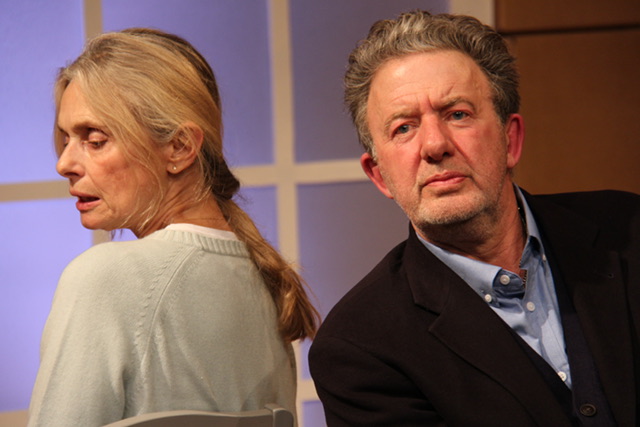
Spanish Oranges, the debut play by acclaimed novelist Alba Arikha, receives its world premiere under the direction of Myriam Cyr and led by Maryam d’Abo, best known for the James Bond film The Living Daylights. Arikha, goddaughter of Samuel Beckett, steps into playwriting with a piece that examines the fault lines between art, marriage, and public scrutiny.
Set over a single morning in a north London home, we walk into a space mid‑unpacking: cardboard boxes labelled with magazines, vinyl, baby clothes, and books (including Virginia Woolf). Advance copies of Fiona’s new novel are stacked in a box and scattered across the tables. It’s immediately clear this is a family who values the arts. And of course, there’s a bowl of oranges — how could there not be, given the title.
The play follows celebrated author Fiona as she prepares for a rare interview about her forthcoming novel, Spanish Oranges. Her husband Ivo, once a respected actor, has been cancelled by a sex scandal, and he suspects her success is built on the ruins of his downfall. Their daughter Lydia (played by Arikha’s own daughter, Arianna Branca) arrives unexpectedly from university, adding another presence to an already unstable morning. The premise promises a sharp examination of shifting power dynamics — love and ambition, truth and narrative, and the porous boundary between public and private life. Arikha draws loosely from Who’s Afraid of Virginia Woolf? and Scenes from a Marriage, though I haven’t read either to comment on the influence directly.
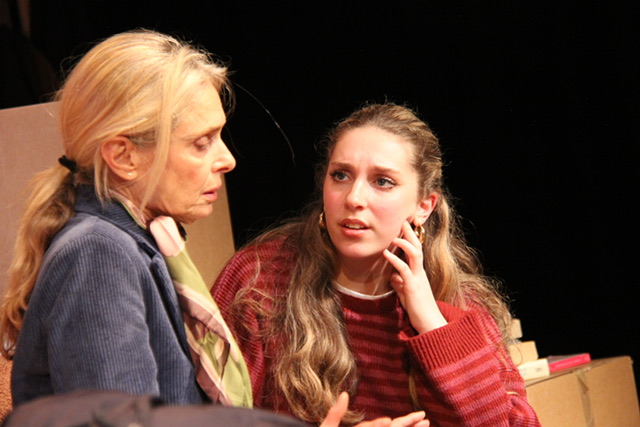
D’Abo brings an immediate sympathy to Fiona; her quiet exhaustion and flickers of tenderness feel lived‑in. Jay Villiers leans into Ivo’s blend of entitlement and self‑pity — a performance that makes the ninety minutes without an interval feel long, but only because the character himself is so wearing. Both actors capture the mental and physical depletion of a marriage in its final stretch. The play’s gentler beats — a shared memory, a hand squeezed in vulnerability — offer brief windows into who these people once were.
The arguments circle the same terrain, becoming repetitive. Tensions escalate too quickly, and the ending — abrupt and predictable — lands with a sense of cliché. I anticipated the final turn within the first few minutes, which dulled its impact. There were a few scattered chuckles from the audience, but the humour never quite found its footing. And while the play touches on sexism, sexual harassment, and the cost of public shame, these themes felt under‑explored. A few details also pulled me out of the world — most notably Lydia’s implausibly swift journey from Newcastle to Camden by midday because a class was cancelled.
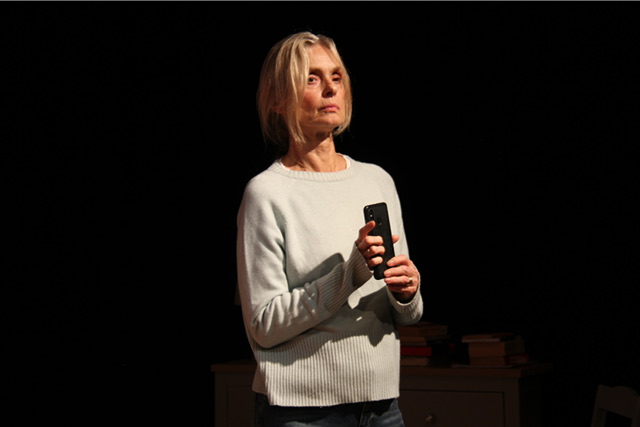
At ninety minutes without an interval, Spanish Oranges is compact but uneven. It shines in its quieter, more vulnerable moments, yet struggles to sustain dramatic tension or offer new insight into the well‑trodden territory of a marriage collapsing. Arikha’s first play shows promise — particularly in its interest in the stories we craft about ourselves.
Performing until 7 March 2026, the production marks the first full staging of a work that premiered in early form at the Women’s Voices Festival at the Playground Theatre in 2025.
Written by Caitlin Neal


